+44 (0)1440 564988
This is a cross post from the excellent blog by professional genealogist and Pharos Tutor Karen Cummings. You may have missed the original, so we make no apologies for posting it again.
__________________________________________________________________________
How do you research your family tree?
It’s not a trick question, I would like to know. There are so many adverts these days for the big commercial websites: “just type your name in and see what you will discover” and I am concerned we may be losing knowledge of how to conduct proper genealogical research.
It’s not a question of clicking links on Ancestry (other commercial websites are available) and adding people to your tree, or, even worse, basing research on shaking green leaves or hints. Yes, you can easily create a family tree this way but, and I say this with tongue in cheek, you could end up barking up completely the wrong tree!
There is far more to genealogical research: knowledge and methodology.
To conduct genealogical research effectively you need an understanding of sources. What sources should you investigate for a particular research need? When were they created and why? What is the likelihood that your ancestor will be included? There are many courses available to increase your knowledge of different sources, such as those from the Institute of Heraldic and Genealogical Studies (IHGS), Pharos Tutors and the Universities of Strathclyde and Dundee. There are also lots and lots of books available, e.g. the “My Ancestor was…” series from the Society of Genealogists and the “Tracing Your … Ancestors” series from Pen and Sword and many articles in the family history magazines.
Even with an understanding of sources there is still a need for caution with the data available on Ancestry, Find My Past and the like. What sources are actually included in a database? Is the database complete or will more records be added later? What are the most effective search techniques and how do you untangle the results you find?
I saw this posted on a social media group recently:
“Which side do you work from and why? Family Tree Maker or Ancestry?”
Aggh! That had me positively jumping up and down on my soap box! Are we really led to believe that “everything is on Ancestry”? Is that what people think? Good quality research considers what sources are required THEN where they are, not the other way around.
This brings me onto methodology. In the UK we really do not give methodology much air time. Our US cousins are far better at formalising genealogy methodology. In my opinion we really need to think about this more.
Two things happened whilst I was at “WDYTYA Live” in Birmingham recently that left me with completely opposing opinions of “the way things are”. Firstly I went to a talk from American, Robert Charles Anderson, on the methodology he describes in his book Elements of Genealogical Analysis. It describes a systematic methodical approach to analysing your research and coming to sound conclusions. Some of you may be familiar with the Genealogical Proof Standard, more commonly used in the US but, again, a sound methodology to establishing “proof”. That deserves a series of blog post on its own so I won’t go into it further here. I thought Mr Anderson’s approach was excellent but around half the audience got up during the talk and walked out. Was it just the American records bias of the talk or are people really no longer interested in doing things properly?
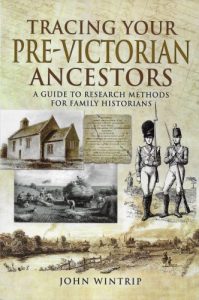 At the complete opposite end of the scale, a new book had just been published by Pen and Sword from a colleague of mine, John Wintrip, Tracing Your Pre-Victorian Ancestors. The title is deceptive and really does not show it off to the best of the publisher’s abilities. Yes, there is much discussion on the specifics of research in the pre-Victorian period but it is the subtitle that is important: A Guide to Research Methods for Family Historians. I understand that it was sold out by the end of day 2, and I certainly did not see any copies for sale on the last day, so maybe we are still taking this seriously after all.
We need more of this in the UK: Sound advice on how to conduct proper, good quality genealogical research.
John starts by considering the skills and knowledge needed for genealogical research and breaks this down into four areas:
- knowledge of sources
- searching skills
- analytical and problem solving skills
- external knowledge
There are chapters on sources, distinguishing between original and derivative sources and records, and search techniques, including how to get the best from online databases.
Special consideration is given to names, social status, religion, occupations and migration and how these may affect your research journey but there is much focus on methodology: using archives, evidence and proof and techniques such as family reconstitution.
John’s book describes research techniques as used by the professionals and those who take their family history seriously. It introduces the concept of considering the records you are using in the context of what was happening from a historical perspective at the time. Filled with useful case studies from his own research John teaches you to consider the wider picture. Is it possible that a birth you may be looking for is not where you thought because the father was in the militia at the time and stationed elsewhere?
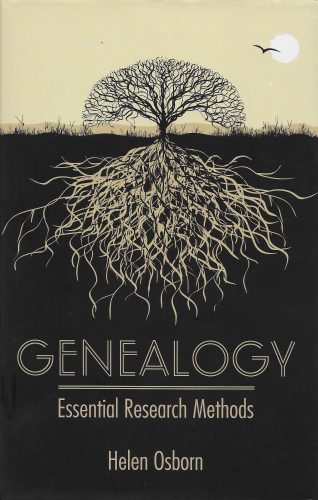
We do not have a lot of information about genealogy research methodology in the UK. The only other recent publication that comes to mind is the also excellent Genealogy: Essential Research Methods from Helen Osborn. Taking a slightly different approach to John Wintrip’s book I heartily recommend both volumes to anyone serious about their research.
Please, and I know I have used this word repeatedly, can we do this properly?
__________________________________________________________________________
Find out more about Karen here
A1. I got lazy (or at least weary) upon retirement after a rough final year on employment followed by hip surgery.
A2. I vainly thought I could wing it through organising an extended house sale and move, developing woodcarving hobby skills, and completing my moribund family history projects.
A3. I did not recognise the need for, and then maintain, a project-management approach to the latter two dreams - did not define them as Project Goals. During a FutureLearn / Strathclyde University MOOC Course on Genealogy in January 2018 the penny dropped.
A4. In reaction to its process-led instruction, I intuited that I must adopt a product- or goal-led strategy and discipline to motivate my persistence.
Therefore: Now I define myself as self-employed, still able to apply consultancy skills (arthritis and insomnia permitting)! Self motivated and enterprising, no corporate wage-slave. For efficient navigation I designed a 3-level Project Plan and uploaded its schedule of Stages and primary Tasks into my project profile at http://one-name.org [search on Gracey]. Please critique it if you can be bothered. I'm currently unpacking it further into detailed tasks driven by a schedule of practicable products and a feasible timescale. How SMART dare I go? Can I treat my person family history likewise? Plenty of CPD challenge too.
Reflection: In all my years of reading about Family History research I have never found a serious treatment of the endeavour (hobby) that applies professional-level, project management expertise to its work. Except now. Perhaps I have found my USP for a shunned blog. Engineer shakes down history! Can you envisage an activity-on-node network for the task iterations in your 3 stages? How can you be confident you will reach your goal within your age/energy quota? - unpack and assess implicit assumptions? How obtain more resources, including an apprentice / heir? I ask myself too.
Some of the course exercises made me re-visit the rigorous project plan I designed 3 years ago for my ONS (before retirement made me procrastinate-y). I realise now that such a structured plan, using my expert project management training, is "precisely as I would like". That's the way I earned a living, productively and efficiently, in running projects. It suits the way I think (though bores some folk cross-eyed). So I intend to create a similar project plan, with hierarchic stages and iterative passes, for my general family history "work". I must add a tentative time-schedule to both. Then operate the two projects in parallel. Hurrah for 2020's New Year Resolution.
I now have both these books . Plus the Pharos Tutors excellent courses at reasonable prices are invaluable for learning to do research the right way