
+44 (0)1440 564988
An article by Joe Saunders
June is Pride Month, a time of celebration and also commemoration, which has been observed in many places across the world following the 1969 Stonewall riots, a series of gay liberation protests in the United States.[1] It is a good time to consider how we might look into the queer histories of our own research into people and places.
Queer people been an ever-present thread within history, as shown by this timeline produced by English Heritage. For some people their sexuality and/or gender ‘has shaped the way they contributed to social, political or cultural history, for example through art or activism’, while for many this was just one aspect of their lives and identities.[2] Despite the constant presence of queer people in the past, expressions of same-sex love and gender nonconformity have been restricted by negative social attitudes and legal restrictions throughout much of British history. However, ‘by uncovering the LGBTQ+ stories that have survived, researchers can start to represent the true diversity of sexuality and gender’.[3]
Because of social and legal restrictions, LGBTQ+ people are not always reflected wholly in historical sources. It is important to note that often vague or coded language was used to obscure LGBTQ+ presence and histories. It is also key to be alert to the changing language used by queer people themselves, and others referring to them, when searching for and reading records. A glossary of terms is available through The National Archives’ guide to ‘Sexuality and gender identity history’.
Once armed with the relevant terminology and an awareness of the social and legal contexts it is possible to undertake research in a variety of sources. Record sets commonly used by the family and local historian such as censuses, wills or newspapers can show aspects of queer lives when read intelligently. For instance, a will may leave a substantial sum of money to a friend, indicating a present or former partner, or census records might consistently show an unmarried queer couple living together. As with all good research such references will need to be corroborated with other sources. If fortunate, we may come across personal sources such as letters or diaries which are much more direct.
Due to the historic criminalisation of gay people there exists a large body of criminal records which might be consulted. Particularly useful may be Home Office papers, held at The National Archives, where petitions and correspondence regarding sentences may be located. Though as female homosexuality was never explicitly criminalised in the UK lesbians are under-represented in these records.
There are archives which specialise in collecting LGBTQ+ history, such as The Lesbian Archive in Glasgow Women’s Library. One of the ‘most extensive collections on LGBTQIA+ history, politics and culture’ in Britain is held at the Bishopsgate Institute in London.[4] Their collection includes a library of 10,000 titles, including academic books as well as biographies and poetry, along with archives from queer organisations and projects such as Stonewall, Switchboard and LGBTQ+ History Month.
There is a rich and growing field of research in this area which can inform our understanding of, and research into, queer history. The Royal Historical Society has published a useful guide to getting started with LGBTQ+ histories, including a reading list and links to archives, networks and heritage organisations.
One standout handbook which suggests sources and search tools for researchers is Norena Shopland’s A Practical Guide to Searching LGBTQIA Historical Records (2021).
We also have a talk from Gill Rossini on Researching LGBTQ+ Ancestors in our Webinar Week, booking now.
Sources
[1] For more on the riots see, David Carter, Stonewall: The Riots That Sparked the Gay Revolution (2015).
[2] Hannah Elizabeth, ‘A Timeline of LGBTQ+ History in England’, English Heritage, https://www.english-heritage.org.uk/learn/histories/lgbtq-history/timeline/.
[3] ‘LGBTQ+ History’, English Heritage, https://www.english-heritage.org.uk/learn/histories/lgbtq-history/.
[4] ‘LGBTQIA+ Archives’, Bishopsgate Institute, https://www.bishopsgate.org.uk/collections/lgbtqia-archives
Image credits
‘Two people dressed as husband and wife’, LSE Library. Public Domain (CC BY-SA 2.0)
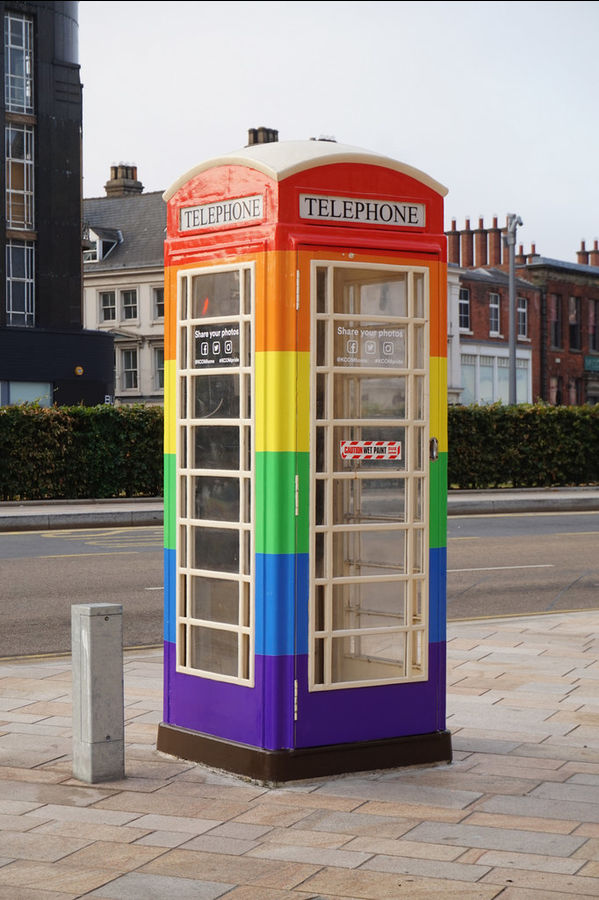
Ian A, Gay Pride telephone kiosk on Carr Lane, Hull (CC BY-SA 2.0)